The digital revolution has transformed many industries, but perhaps one of its most unexpected effects is the surge in demand for eagle-eyed proofreaders. As businesses, content creators, and publishers rush to produce online content, a new opportunity has emerged for those with a sharp eye for detail.
This surge in digital content isn’t just creating more typos—it’s opening doors for people to turn their grammatical skills into a flexible side business.
The trend has caught the attention of everyone from stay-at-home parents to young professionals looking for additional income streams. What makes this opportunity particularly interesting is its low barrier to entry: while traditional proofreading roles often required English degrees or publishing house connections, today’s digital proofreaders need only a keen eye for detail and the right training.
What Modern Proofreaders Really Do (And Don’t Do)
So what exactly do modern proofreaders do? Unlike the red-pen-wielding grammar police of the past, today’s proofreaders are digital professionals who help businesses, content creators, and authors put their best work forward. It’s not about rewriting content or fixing plot holes—it’s about catching those pesky typos, formatting inconsistencies, and fixing punctuation errors that could hurt a writer’s credibility.
The beauty of proofreading in 2025 is its flexibility. An English degree or publishing house connections aren’t required. What is needed is a sharp eye for detail, a solid grasp of grammar rules, and the willingness to learn the craft properly. In today’s connected world, proofreading work can be done from almost anywhere.
Kristyn, a Proofread Anywhere Graduate, shares how proofreading can fit into even the busiest of lives. “Getting my first client was such a huge confidence booster,” she says. “I could work my schedule around my busy life, which is filled with homeschooling, being a wife, and I could contribute to my family’s finances. Once you have your first client, that can have a ripple effect and give you more work as the days and weeks go by.”
Your Path to Proofreading Success
Getting started as a proofreader is pretty straightforward. First up is learning the actual craft: catching errors like a professional. Confidently getting and communicating clearly with clients comes next — and it’s much easier than many people assume.
Would-be professional proofreaders often ask “Will I find enough work?” or “What if I miss something important?” These are normal concerns, but they’re easily addressed with a solid training program. The right program teaches the “insider” tricks of the trade: proven techniques for catching errors, setting rates that make sense, and connecting with clients who value high-quality work. Everything builds from the basics: proper proofreading marks, understanding style guides, and getting comfortable with professional tools.
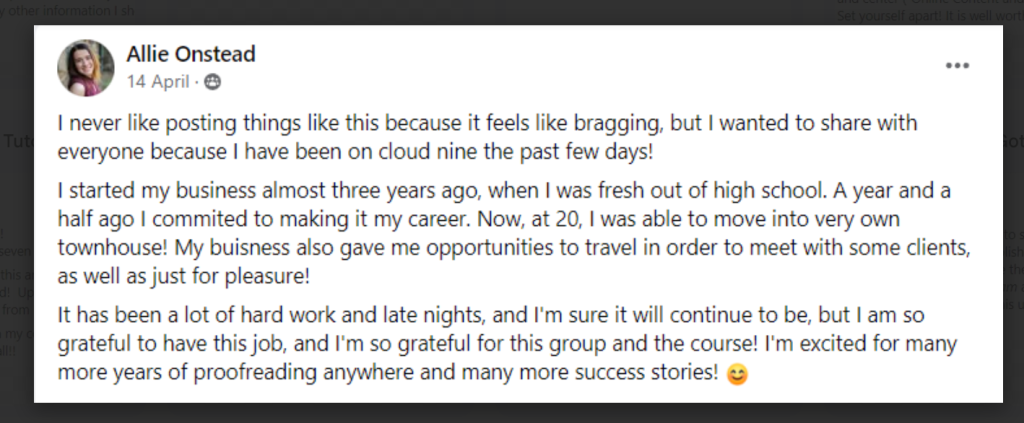
We caught up with Allie, who started her proofreading business right after high school. “At 20, I was able to move into my very own townhouse!” she shares. “It has been a lot of hard work and sleepless nights, and I’m sure it will continue to be, but I am so grateful to have this job.”
Michael is another example of what’s possible. When money got tight, he turned to proofreading to help support his family. What started as a short-term solution turned into something much more interesting.
“I’ve had countless clients since graduating,” he shares. “Every year is better, and I’m only moving forward.” Now, Michael has parlayed his proofreading skills into a successful copy editing business.
Create Your Own Flexible Income Stream
The path to sustainable proofreading income isn’t about luck—it’s about strategy and consistency. Instead of jumping in blind and hoping for the best, successful proofreaders invest in learning the business side too—from setting up their work processes to marketing their services effectively.
Tiffany Hice, a successful proofreader, puts it plainly: “If you’re willing to put in the work, you’re definitely going to see the results.”
The first step is to choose a specific and interesting niche. Some proofreaders focus on academic papers, while others prefer creative writing or business content. The key is finding an area that matches both skills and interests. Business documents might appeal to those with a corporate background, while book manuscripts might excite the avid readers among us.
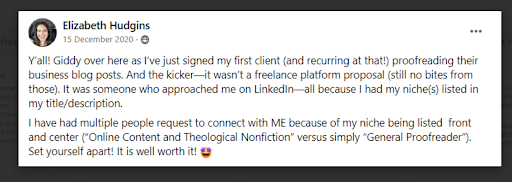
Elizabeth’s success shows how this niched, targeted approach pays off. “Giddy over here as I just signed my first client (and recurring at that!) proofreading business blog posts,” she shares. “And the kicker—it wasn’t a freelance platform proposal. It was someone who approached me on LinkedIn—all because I had my niche(s) listed in my title description.”
Amanda Cummings is another proofreader who found her sweet spot in the proofreading world and hasn’t looked back: “I’ve been generating over a thousand dollars a month easily, and it just keeps continuing to grow.”
The key is treating proofreading work like a real business from day one. Set dedicated hours, even if they’re just a few per week. Create a professional work environment, whether it’s a corner of your dining room or a local library. And most importantly, invest in learning the right ways to find and keep clients.
With dedication and commitment, these proofreaders are showing it is possible to turn attention to detail into consistent income from an enjoyable side business. Sarah Larson went from a curious beginner to a booked proofreader in just two weeks. “I absolutely love my proofreading business, and I’ve just been able to keep growing it,” she shares. “I definitely wouldn’t have had the steps to get there without proper training.”
Ready to Turn Your Eye for Detail into Extra Income?
For those interested in exploring proofreading as a side business, several resources are available. A highly popular starting point is a free introductory workshop provided by the aptly named Proofread Anywhere team. It covers the foundations of professional proofreading, common pitfalls to avoid, and practical strategies for finding clients.
According to the data, the typical earning potential for a professional proofreader is anywhere from $500 to $3,000 per month—combined with flexible schedules and setting their own terms.
As graduate Tami explains, “It doesn’t just stop with learning about proofreading. [Proofread Anywhere] takes that extra step to teach you what you need to know about getting clients, setting up your website, and the nuts and bolts of actually marketing yourself. They take you from the baby stage all the way up to the full graduate stage.”
The Proofread Anywhere workshop includes access to a comprehensive proofreading starter guide and provides practical insights for anyone considering this flexible side business opportunity. No pressure, no hype—just practical insights to help decide if proofreading is a solid fit for would-be professional proofreaders.
Anyone interested in learning more about Proofread Anywhere’s free workshop can visit this link:
The tips on finding a niche and setting up a solid business plan are also really practical for anyone looking to get started.
Many people choose to freelance, can take on many different projects from different sources.
it’s about strategy and consistency
Absolutely! Strategy and consistency make all the difference.
Hi! Some of the reviews and success stories you’ve cited are from five years ago. Is there still, in mid-2025, growing demand for human proofreaders, or are people starting to trust AI more and now increasing their use of it instead of humans?
Great question! While AI tools are becoming more common, there’s still strong and growing demand for human proofreaders, especially in areas where accuracy, tone, and context really matter, like publishing, legal, academic, and business writing. AI can assist, but it can’t replace the sharp eye and nuanced judgment of a skilled human proofreader.
THANK U, SO FUN!
Seeing Kristyn share her first client success really hit home. It shows how proofreading can fit into busy lives, like juggling homeschooling and family.
The point about specialized niches, like technical manuals, being a key growth area really stood out. It makes the shift to remote work feel less like a trend and more like a structural change in how we value these skills.
this is a clear and practical look at a growing niche. the point about the low barrier to entry is particularly relevant, as it shifts the focus from formal credentials to actual skill. the section distinguishing what modern proofreaders do and don't do adds helpful clarity for anyone considering this path.